Spotlight
One page per addition that a line on the releases page does not carry: what it is, screenshots of it running, and the video if there is one.
August 2026
Newest first.
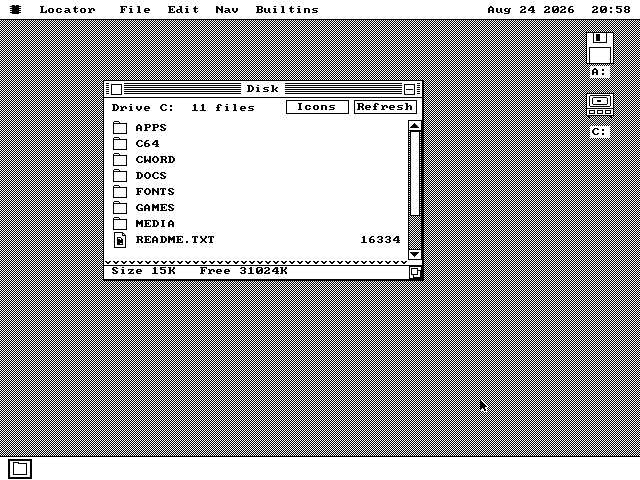
No floppy drive needed
Boot os8088 from a USB stick or a CD
One 32MB drive C with every program on it, and nothing to install.
os8088 has always shipped as floppy disk images, and hardly anything still has a floppy drive. Write one new file to a USB stick, or burn the other to a CD, and a real PC starts straight into the desktop -- both word processors, the story reader, the CP/M emulator, the Commodore 64 and every game already on drive C, with about 30MB free to save into.
- drive C holds
- every program
- free space
- about 30MB
- needs
- legacy BIOS boot
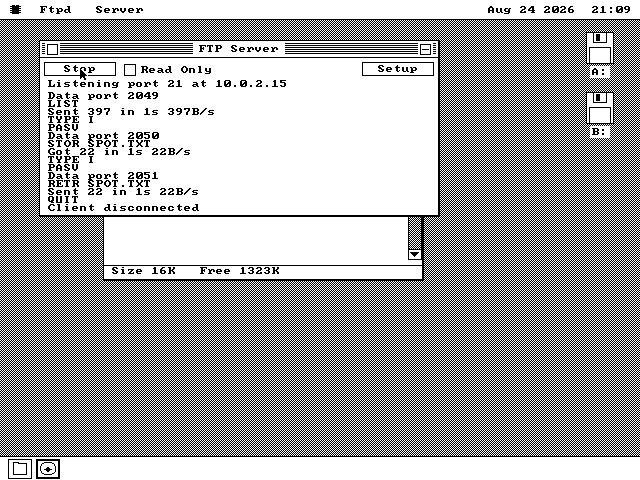
The machine answers
An FTP server on a 1981 IBM PC
Drop a file onto the machine from a laptop, while it is running.
Every earlier network program reached out -- a web browser, a Telnet client. This one answers. Another computer on the same network connects, asks the questions, and gets its answers off this machine's own floppies. On a real IBM 5150 the transfer rate went from 7 KB a second to 30 KB a second over one working session.
- clients
- one at a time
- measured on iron
- 30 KB/s
- encryption
- none, by nature
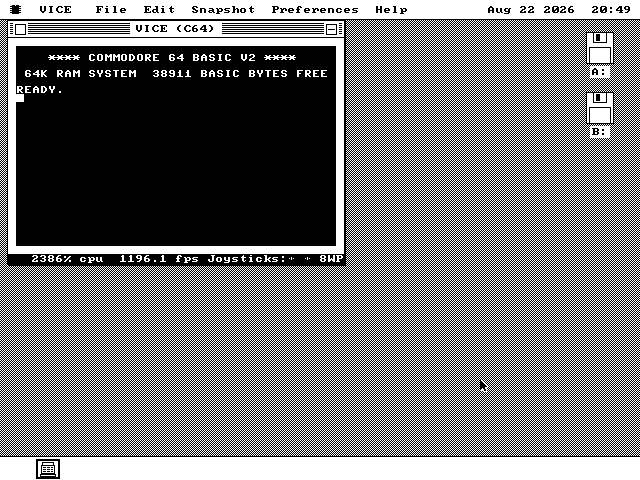
First impressions
VICE brings the Commodore 64 to os8088
Commodore BASIC and VIC-II graphics -- with a 386 or faster required.
VICE 3.10 supplies the model of the 6510 processor, screen chip and both timer chips. os8088 puts them behind Commodore's own ROMs in a window. An XT or 286 can start the emulator, but neither runs it at a useful speed. The port was developed with assistance from Claude Code and Codex by OpenAI.
- software
- VICE 3.10
- guest
- MOS 6510, 64KB RAM
- required host
- 386 or faster
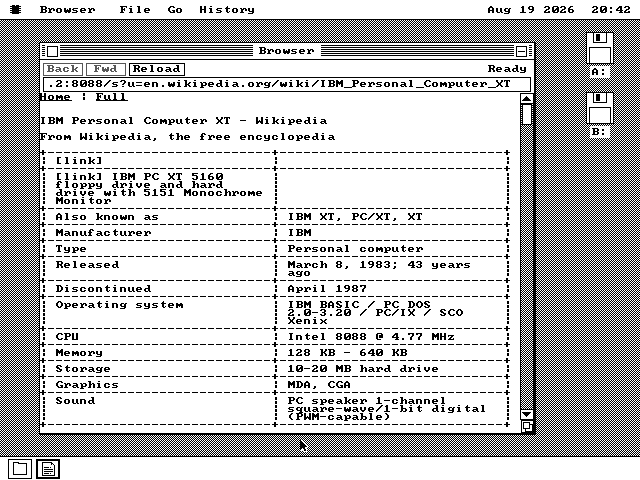
A new program
A web browser for the IBM PC XT
os8088 now fetches real web pages and lays them out as text and tables, over an Ethernet card or a parallel cable to a DOS machine standing next to it. The network is not the slow part: drawing a window full of text takes longer than fetching the page.
- the browser
- 13,889 bytes
- the stack
- ARP to TCP
- machine
- 4.77 MHz 8088
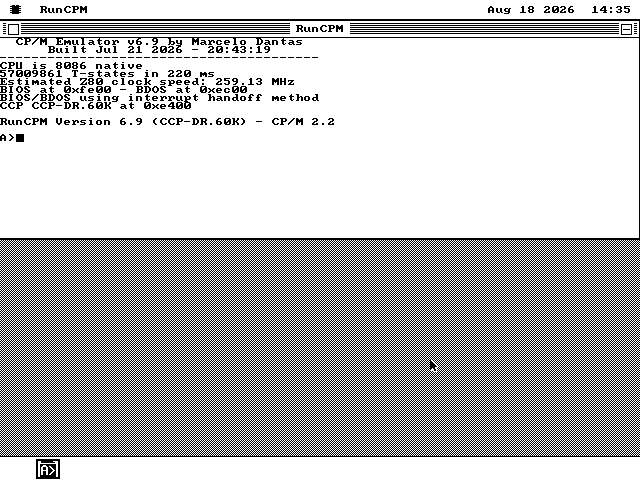
CP/M, in a window
CP/M was the operating system small computers ran before the IBM PC existed, on a processor the PC does not have. os8088 now emulates that processor, so CP/M software runs here: the 1979 command processor at the prompt, Microsoft BASIC, an assembler and an editor, in a window you can drag around like any other.
- emulates
- a Zilog Z80
- written in
- 4,679 lines of C
- machine
- 4.77 MHz 8088
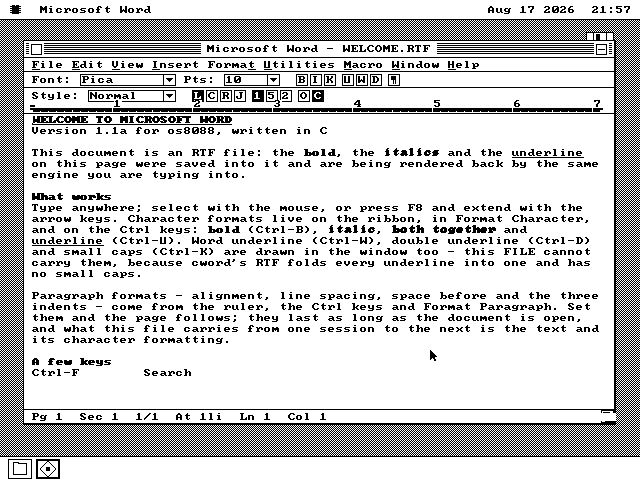
A new program
A word processor written in C
Everything in os8088 up to now was written in assembly language, one processor instruction at a time. There is now a C compiler for it, which is a far quicker way to write a program. To find out whether it could carry something real, I wrote a second word processor with it -- and it turned out too big for the memory a program gets, so it comes in two pieces.
- written in
- 8,350 lines of C
- the program
- 54,450 bytes
- machine
- 4.77 MHz 8088
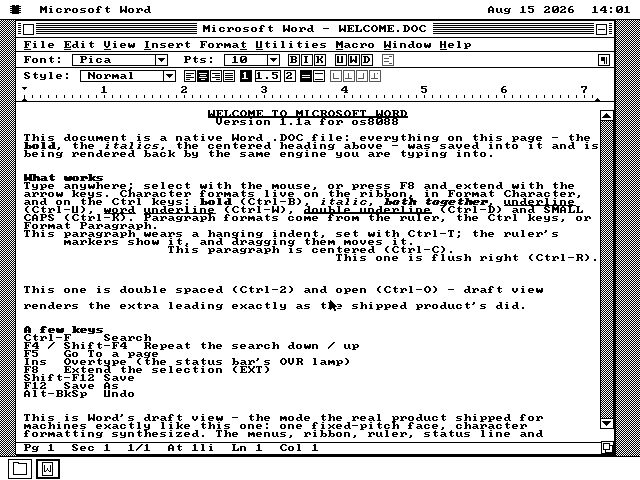
A new program
Microsoft Word, on an 8086
I have added something I have wanted to see for a while: my own os8088 version of Microsoft Word 1.1a. It has the familiar 1990 menus, uses the same clever tricks to show bold and italics on a plain old PC screen, and saves Word .DOC files. The whole program fits in 47KB.
- the program
- 47,212 bytes
- saves
- Word .DOC files
- machine
- 4.77 MHz 8088
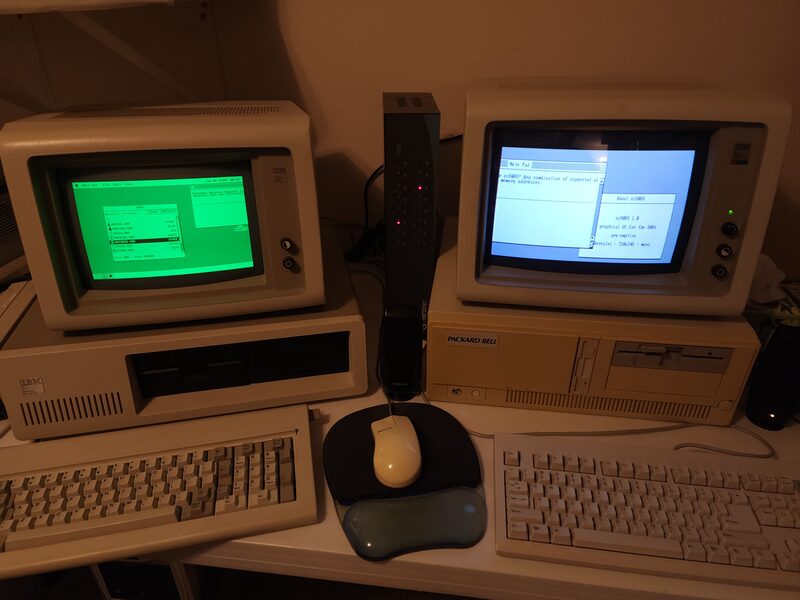
A new feature
Two monitors, one desktop
A PC of this era could hold a monochrome card and a colour card at once, because their picture memory sat at different addresses. Almost nothing used both together. os8088 now spans one desktop across the pair -- 1,360 pixels wide, on a 4.77 MHz machine -- and a window that lands over the join is drawn on both screens.
- monitors
- 2
- one desktop
- 1,360 x 348
- machine
- 4.77 MHz 8088
A new program
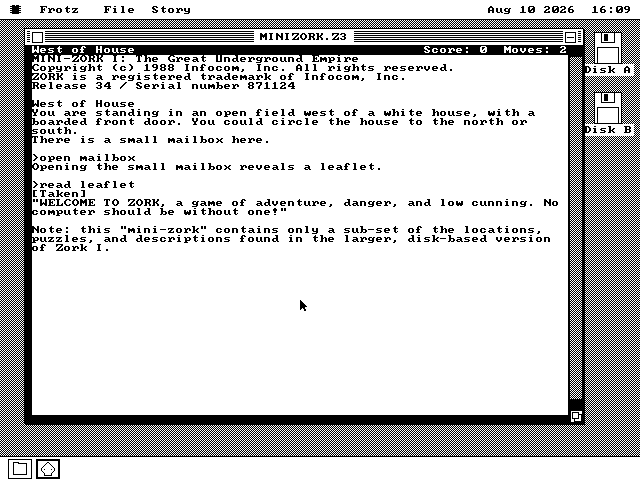
os8088 plays Infocom games now
A Z-machine interpreter in 23,722 bytes of 8086 assembly. The Z-machine is the pretend computer Infocom invented in 1979 so one game could be sold for every machine at once -- which is why a story file from 1982 is still a plain file that still runs. Mini-Zork, Colossal Cave Adventure, Zork: The Undiscovered Underground and Photopia all play, off a floppy of their own.
- the interpreter
- 23,722 bytes
- story formats
- v1 to v8
- games it fetches
- 15