Toshiba Satellite 4025CDT
Laptop
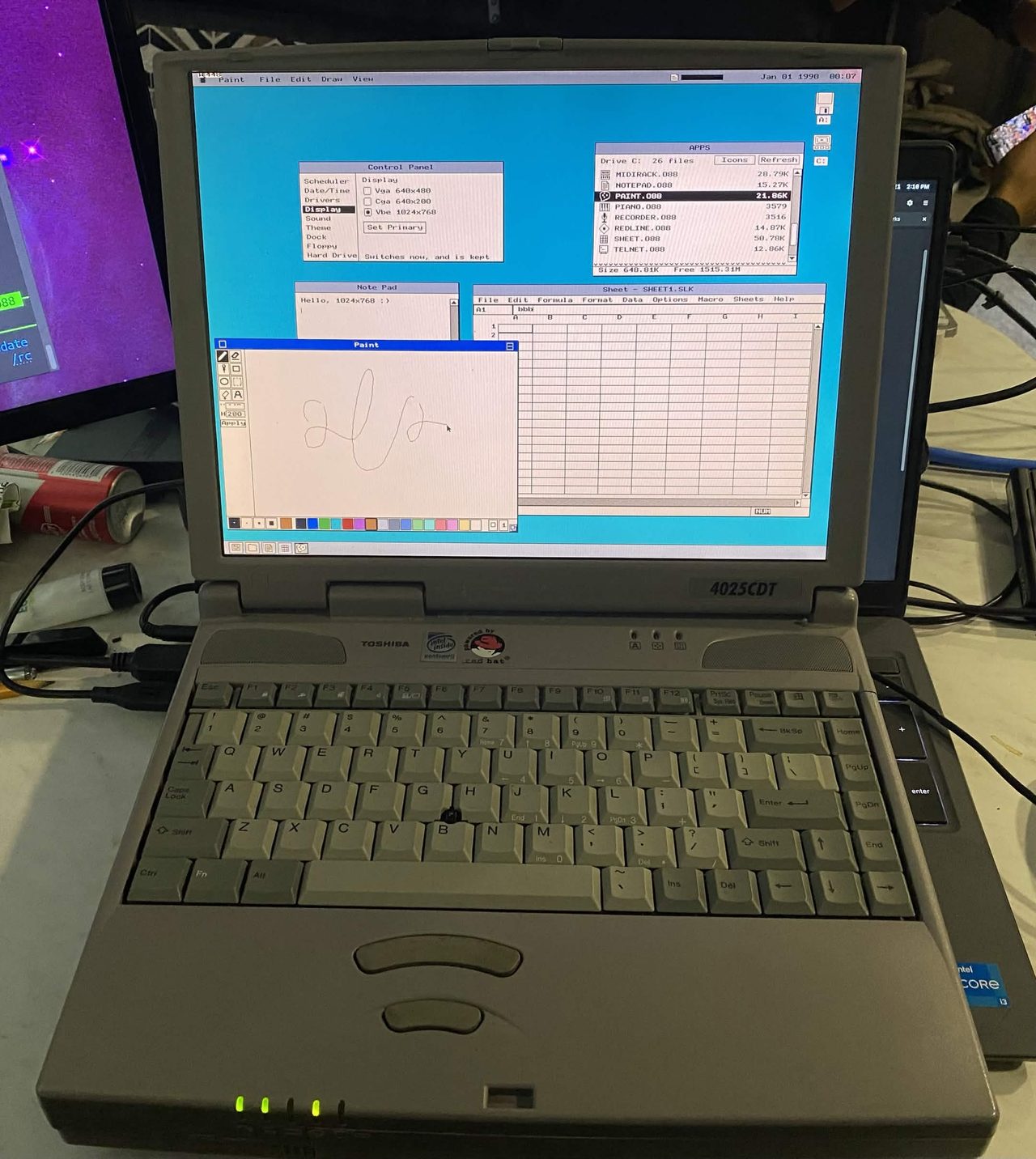
A Pentium II laptop from the late 1990s. It still starts up in real mode like an 8086, so os8088 boots on it as it does on the 5150 -- and its screen has 2.56 times as many pixels as VGA's 640x480.
os8088 on real hardware
See it running
View all photos & details- CPU
- Pentium II
- mode
- VBE, 1024 x 768
- hard disk
- C:, 1515MB free
Manuals & resources
- Satellite 4020CDT Product SpecificationsPDF
- 65555 High Performance Flat Panel/CRT GUI ControllerPDF
- Satellite 4000CDS/CDT flyerPDF
Running os8088?
Share photos of your setup with the community. Open a GitHub issue and attach your images.
Submit your photos on GitHubHistory, photos & source references
The mode is set through the card's own BIOS
A VBE driver by Nullmoment, ahead of the one in the release.
Here the screen is filled by a VBE driver Nullmoment wrote, which sets the mode through the video card's VESA BIOS. The Control Panel's Display page lists it beside VGA and CGA; Set Primary switches to it at once and keeps it for the next boot. That driver is not in the main os8088 tree; since v1.0.20261025 the release images reach 1024x768 with their own, VESA.DRV.
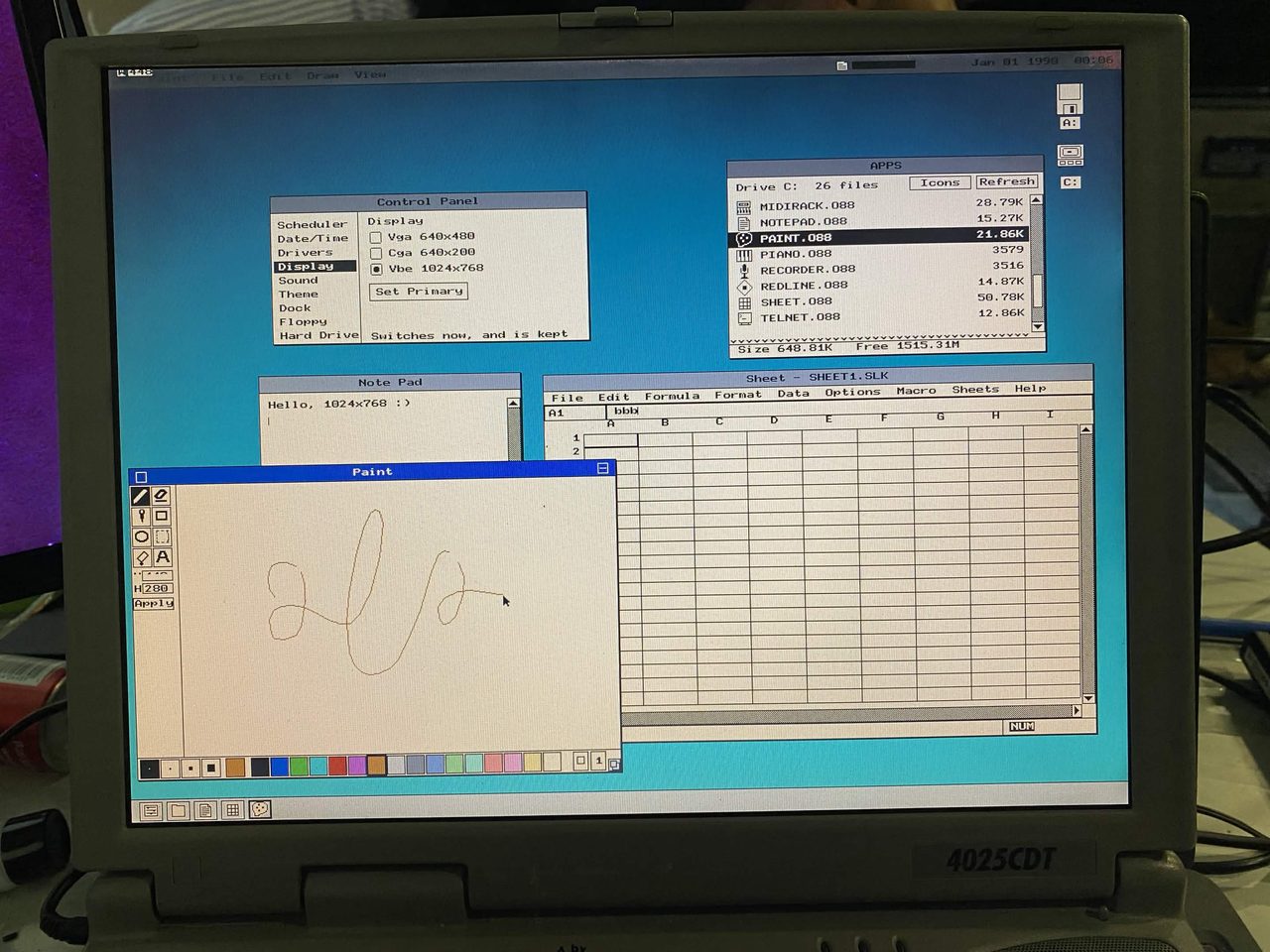
Hello, 1024x768 :).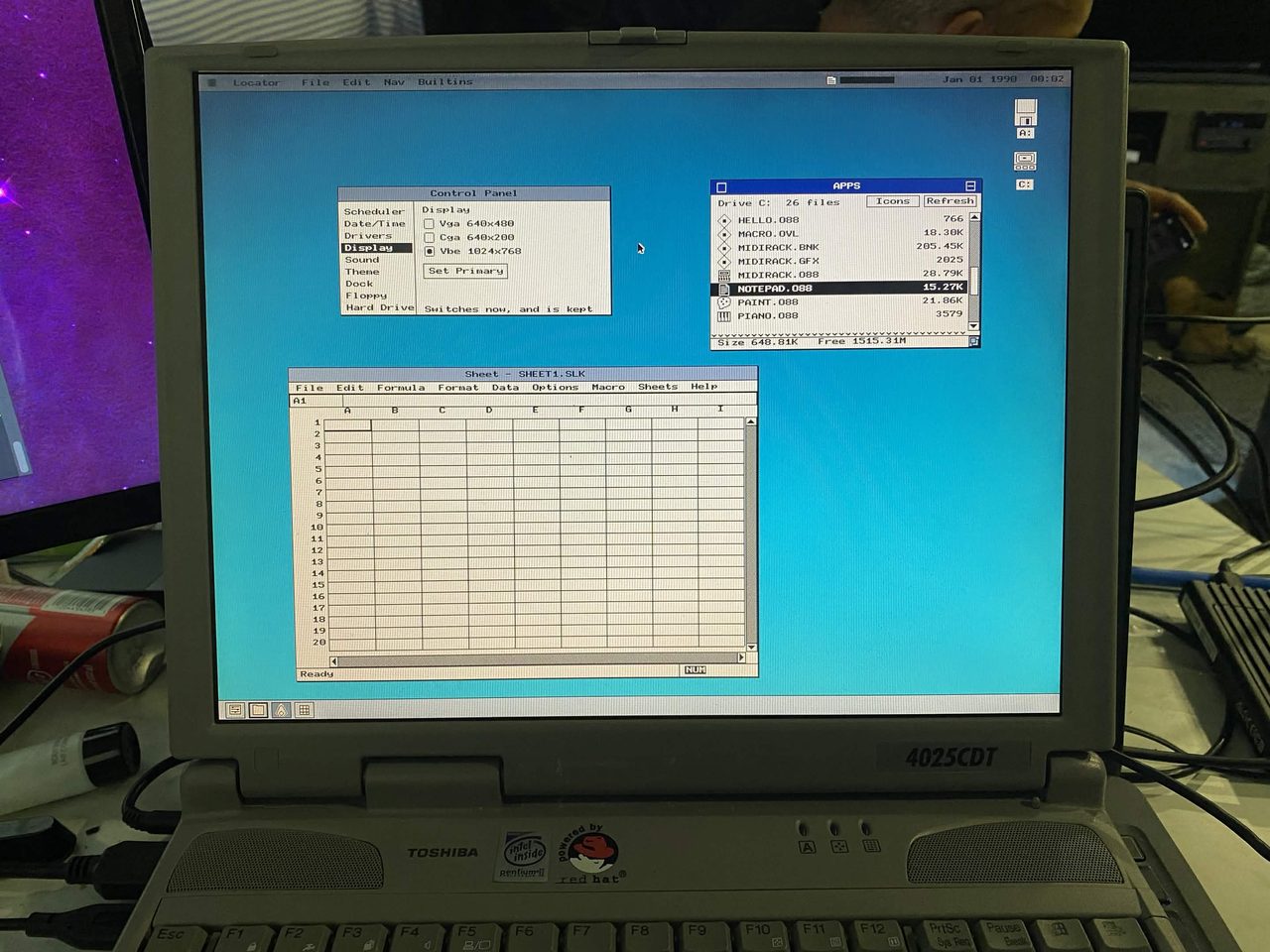
The 4020CDT under a second part number
What the VESA BIOS belongs to, and how far its 2MB goes.
Toshiba's sheets describe one machine twice. The 4025CDT specification and the 4020CDT's agree on processor, memory, screen and disk, and part at the order number and at the software in the box: the 4025CDT has Microsoft Money 98, Quicken Basic 98 and Disney's Daily Blast where the 4020CDT has Prodigy Internet and Norton AntiVirus. Neither sheet says why there were two. DOS Days has the 4020CDT at $2,499 in January 1999, $600 above the 266MHz 4010CDT.
The pair topped the first Satellite 4000 family, which opened in September 1998 at 233MHz with a 12.1-inch, 800 x 600 panel. The graphics chip came from Chips and Technologies, whose datasheet of September 1997 lists VESA VBE 2.0 among the functions of its video BIOS. Its memory is the limit: at the panel's full resolution the chip shows 65,536 colors and no more (the 16.7 million on Toshiba's sheet is for 800 x 600 and below). The 4030CDT that followed in February 1999 dropped to a Celeron and changed to a Trident Cyber 9525 with 2.5MB.
Hard disk, floppy drive and CD-ROM are all inside at once, in a case 2.13 inches thick. The sound chip is a Yamaha OPL3-SA3, which Toshiba lists as Sound Blaster Pro compatible. There is no modem on the board; Toshiba bundled a 3Com 56K PC Card. The lithium-ion pack was rated for two and a half hours.
- processor
- Mobile Pentium II, 300MHz
- memory
- 64MB, to 160MB
- display
- 13.3-inch TFT
- graphics
- C&T 65555, 2MB
- CD-ROM
- 24-speed
- weight
- 7.0lb
Sources
- Satellite 4025CDT Product Specifications Toshiba America Information Systems. The processor, memory, display, graphics chip, drives, sound, battery, weight and bundled software.
- Satellite 4020CDT Product Specifications Toshiba America Information Systems. The same hardware with a different bundle, and the colors at each resolution.
- 65555 High Performance Flat Panel/CRT GUI Controller Chips and Technologies data sheet, September 1997. VBE 2.0 in the video BIOS.
- Retro Review: Toshiba Satellite 4010CDT DOS Days. The January 1999 prices.
- Satellite 4000CDS/CDT flyer Toshiba Europe, September 1998. The first model of the series.
- Satellite 4030CDS/CDT brochure Toshiba Europe, February 1999. The Celeron and the Trident chip of the model that followed.