Advantech PCA-6740
Single-board computer, 2001
A single-board computer built for an equipment cabinet rather than a desk, with its graphics and its network on the board instead of on cards. Babasha's report: everything works.
os8088 on real hardware
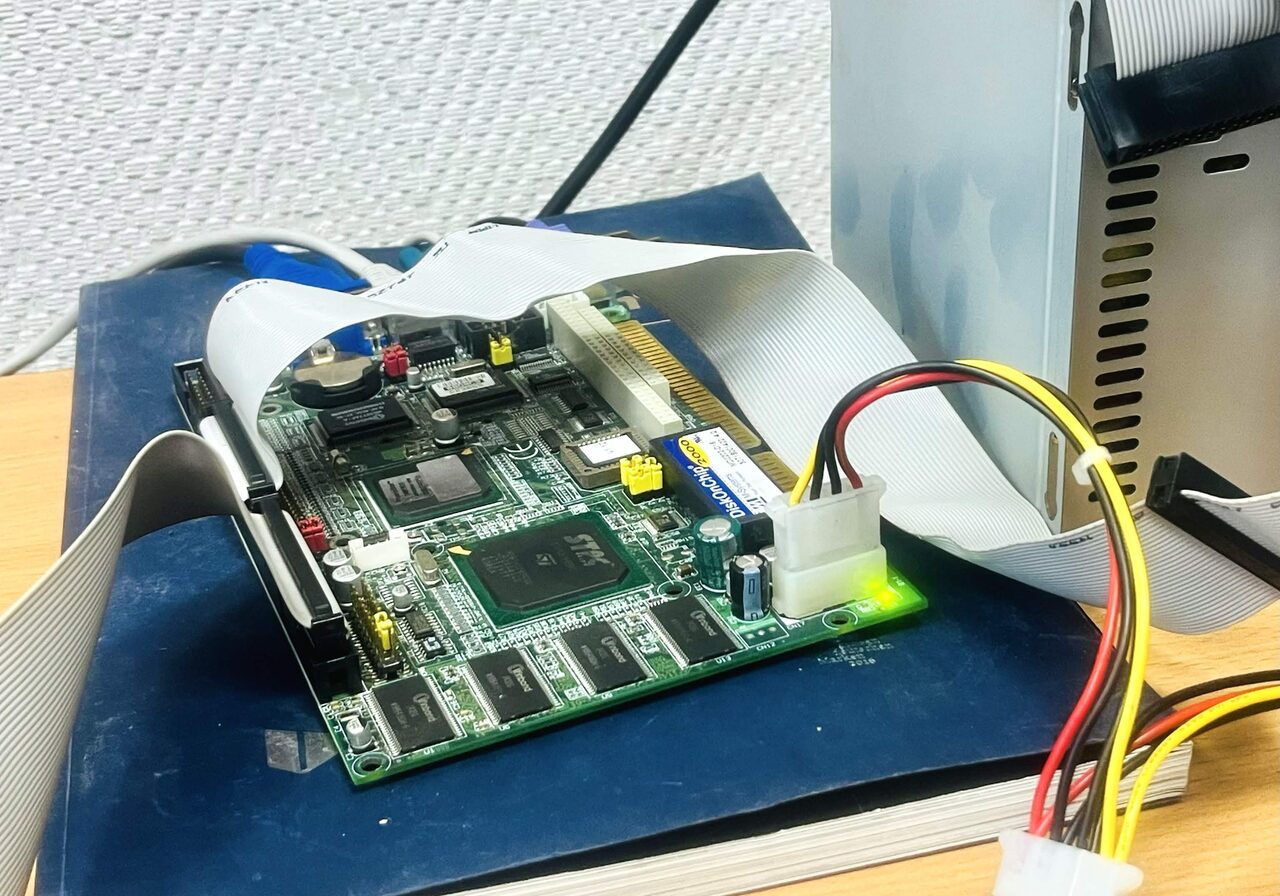
See it running
View all photos & details- CPU
- ST STPC Elite, 133MHz
- RAM
- 32MB
- video
- Silicon Motion LynxEM+, 2MB
- Ethernet
- Realtek RTL8139C
- boot disk
- DiskOnChip 2000, 16MB
- power-on to desktop
- 3.2s
Manuals & resources
All sources & referencesRunning os8088?
Share photos of your setup with the community. Open a GitHub issue and attach your images.
Submit your photos on GitHubHistory, photos & source references
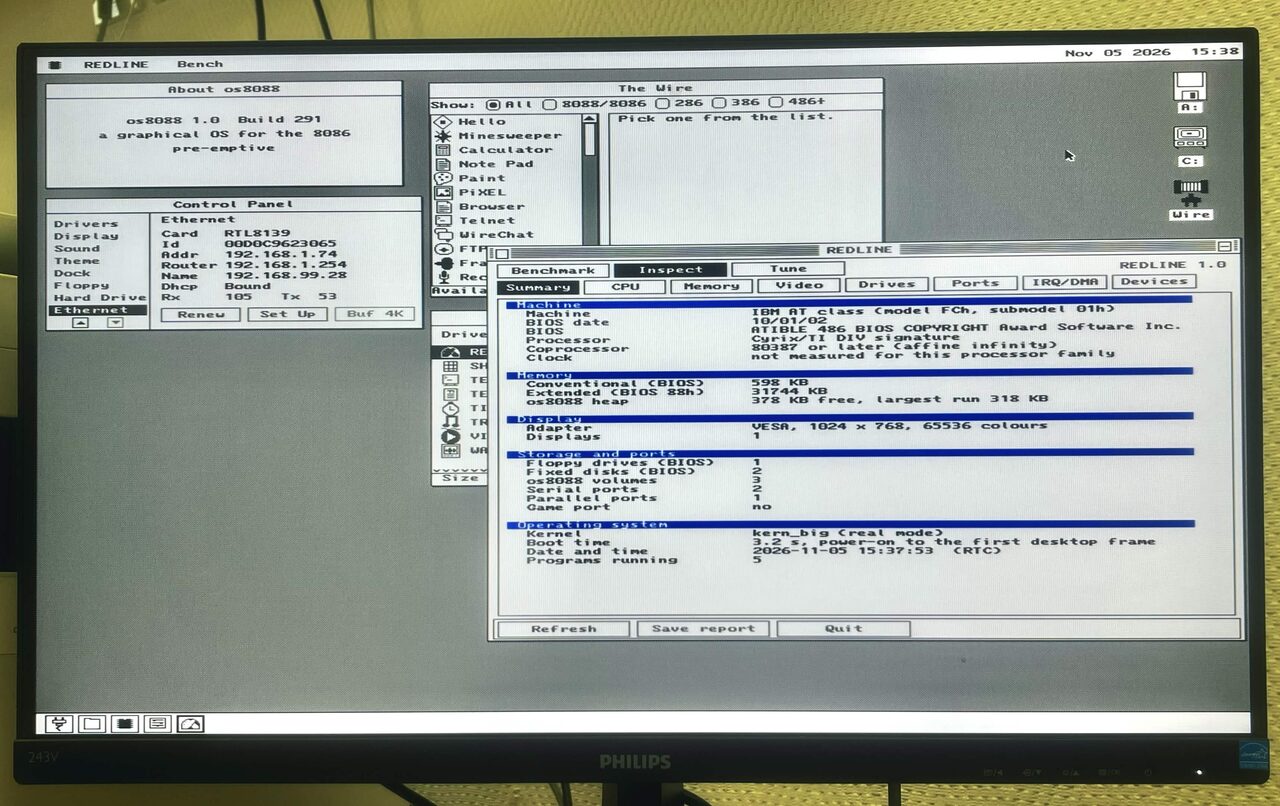
Both on-board chips have drivers in the release
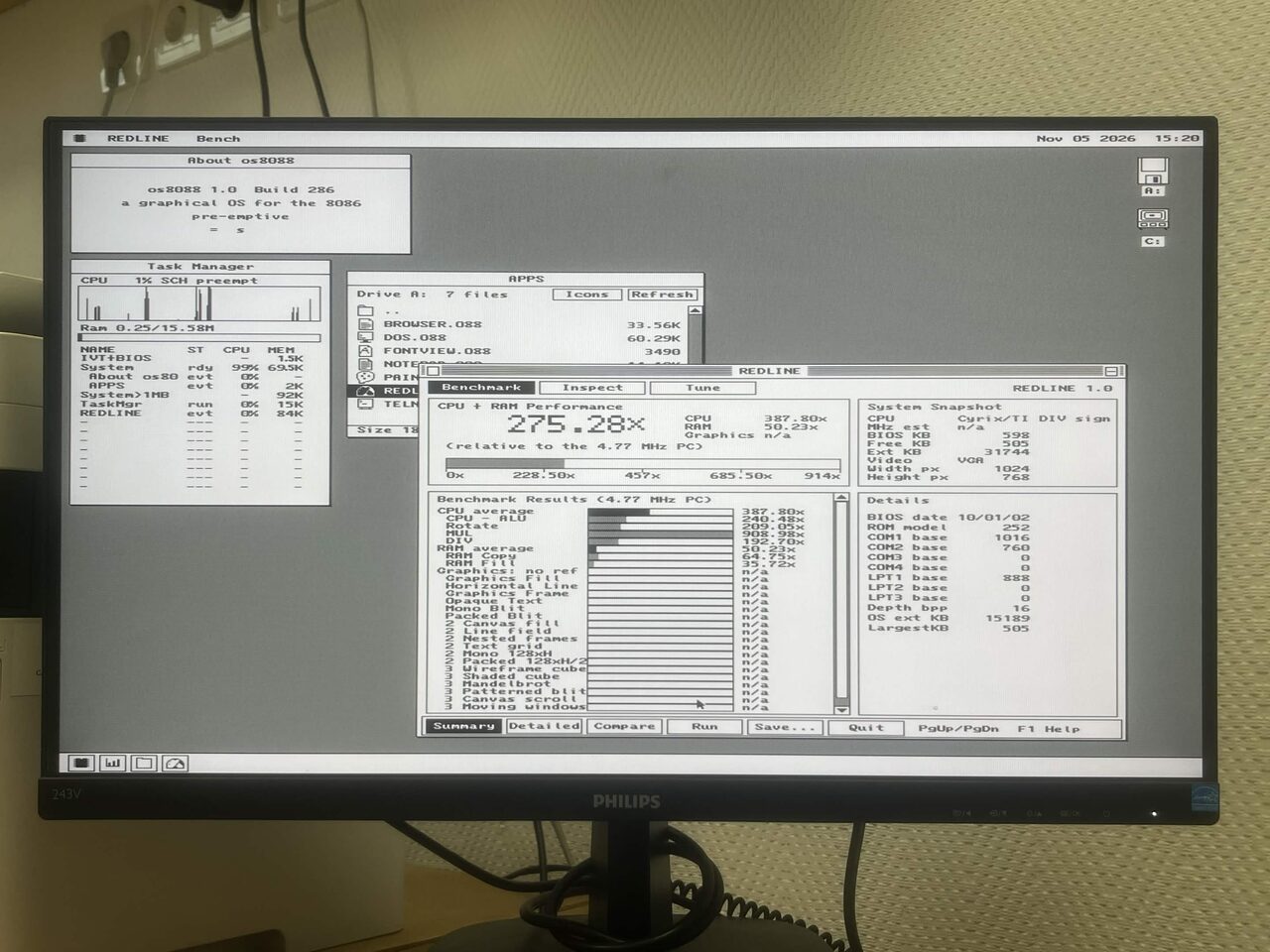
And one thing REDLINE cannot measure here.
VESA.DRV runs the desktop at 1024x768 through the Silicon
Motion chip's VESA BIOS, and PCIETHER.DRV drives the Realtek controller, which
took its address from DHCP. os8088 starts from the DiskOnChip, a flash module in a memory
socket that the machine sees as a fixed disk.
The one thing REDLINE cannot do here is time the clock. It knows the processor only as a Cyrix or TI core, from the flags its DIV instruction leaves behind, and that is as close as it can get: the STPC Elite is an ST part built around a 486 core that Cyrix designed and licensed to ST. REDLINE does not measure that family's speed, so the clock in the box is the board's rating, not a measurement.
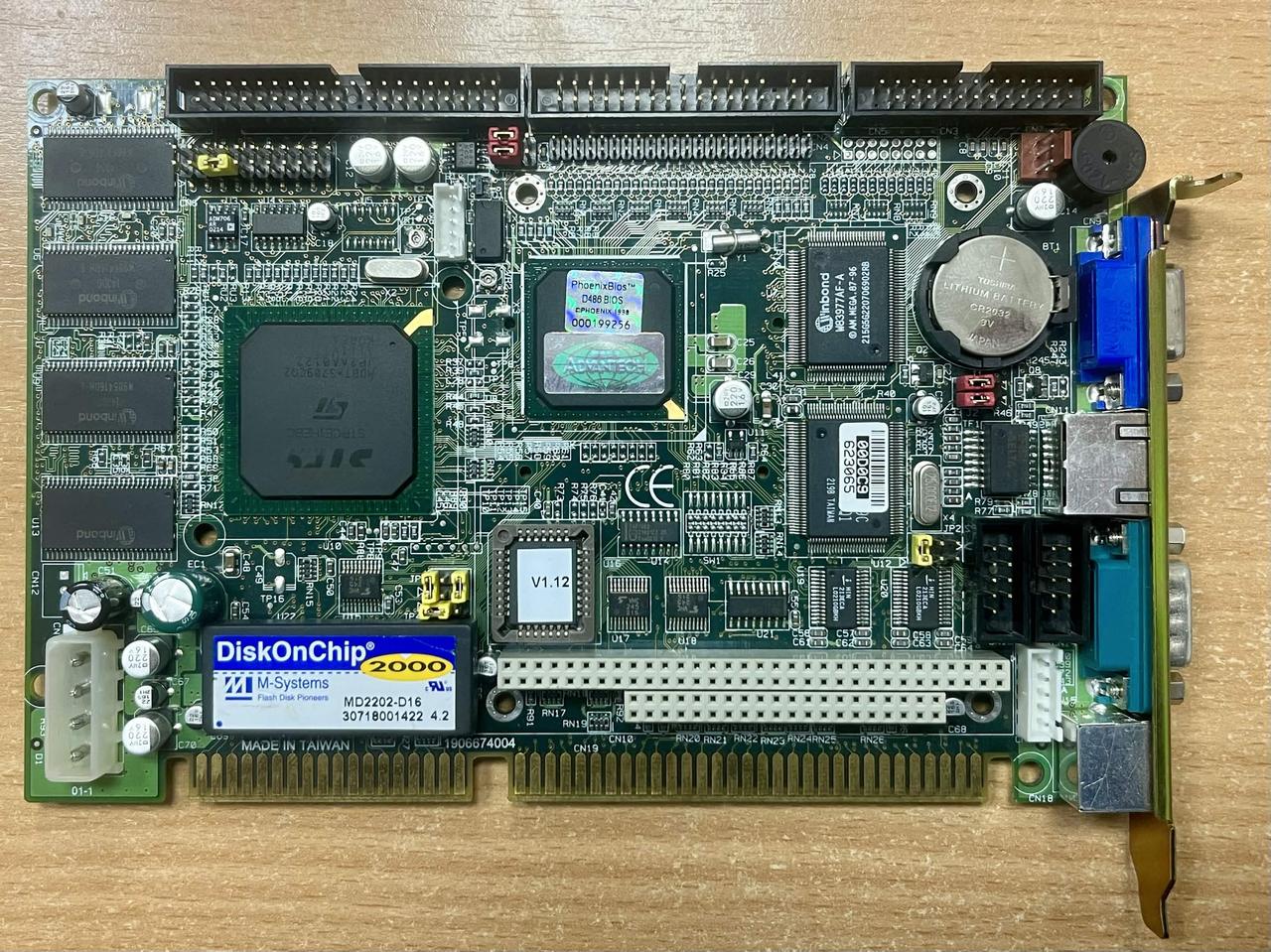
A 1993 Cyrix 486, still in the catalog in 2007
The processor's lineage, and what the board was built to do.
The STPC was not the first PC on a chip (AMD's Elan and National's NS486 were selling before it), but it left less out: the Elan had no FPU, no PCI and no IDE. Microprocessor Report took the first of the family apart in August 1997. The processor is Cyrix's 486DX2 of 1993, redrawn by SGS-Thomson for its 0.35-micron process with the memory bus widened to 64 bits, and ST owned the result outright. ST's simulations put the top speed grade level with a 90MHz Pentium.
The Elite is the member of the family with no display. ST announced it in October 2000 beside the Atlas and the Consumer-II, which both carry graphics; the Elite has sixteen general-purpose I/O lines in their place, at under $26 in lots of 10,000 against under $38 for the Atlas. ST's datasheet offers it for "display-less applications or together with a PCI graphics/video device." Advantech took the second course, with a Silicon Motion chip that carries its video memory inside its own package.
Advantech announced the card for machine controllers such as CNC machines. It has no USB and no audio. A watchdog timer resets it, or raises IRQ 11, when software has not answered for up to 62 seconds. The DiskOnChip socket has a jumper for five addresses from CC000h to DC000h; the BIOS meets the module there in its search for expansion ROMs and runs M-Systems' loader from it, and the loader installs the disk. Advantech's datasheet for the board was last revised in February 2007.
- announced
- October 2001
- form
- half-size ISA card, 185 x 122mm
- memory socket
- SODIMM, to 64MB
- expansion
- PC/104
- power
- 5V only, 1.62A typical
- cooling
- no fan
Sources
- PCA-6740 User's Manual Advantech, second edition, April 2002. The processor, memory, video, Ethernet, the DiskOnChip jumper, the watchdog, power and dimensions.
- PCA-6740 datasheet Advantech, revised February 7, 2007. The variants and the block diagram.
- Announcement: PCA-6740 Advantech, Embedded PC World, October 1, 2001. The date and the intended use.
- SGS Puts 486 PC on a Chip Jim Turley, Microprocessor Report, August 4, 1997. The Cyrix core, what ST changed in it, and the comparison with the Elan.
- STMicro announces x86- and RISC-based processor lines EE Times, October 9, 2000. The Elite's announcement and prices.
- STPC Elite datasheet STMicroelectronics, January 29, 2002. What the chip holds and what it leaves out.
- DiskOnChip 2000 DIP Data Sheet M-Systems, September 2004. How the module is found and becomes a disk.
- RTL8139C(L) Datasheet Realtek, December 29, 2005. The Ethernet controller.