Spotlight › Byteopoly
Byteopoly
A board game about collecting old computers. Buy the Commodore PET, the Apple II and the IBM PC XT, collect a maker's whole set and charge rent, on one PC or on two joined by a cable.
- Players
- 2 to 4
- Computers to collect
- 16
- PCs in one game
- 1 or 2
01 / What it is
What it is
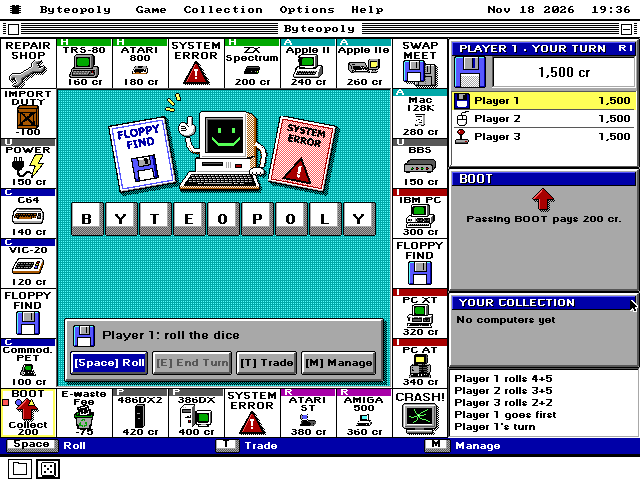
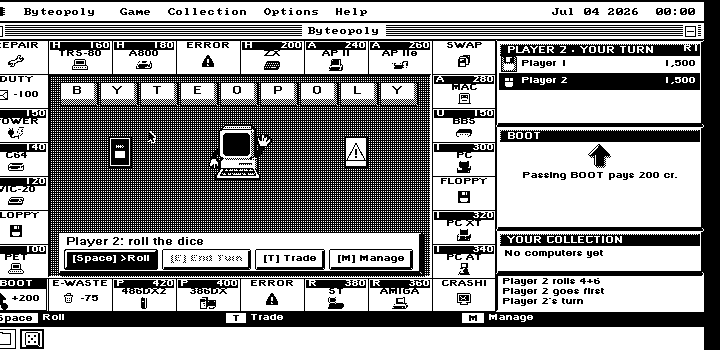
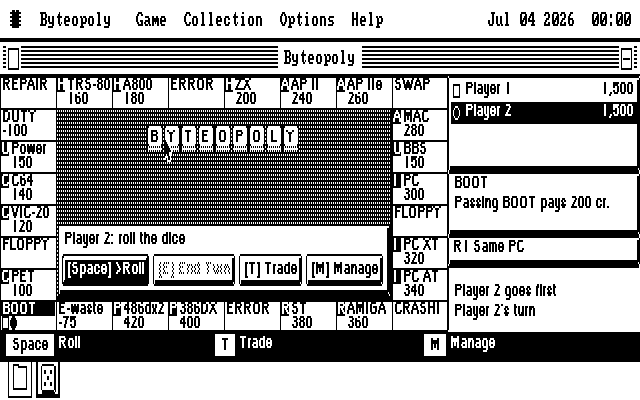
Byteopoly is a property-trading board game, the kind where players go round a square board, buy what they land on and charge rent to anyone who lands there after them. The last player with money left wins. Here the properties are home computers from 1977 to 1992.
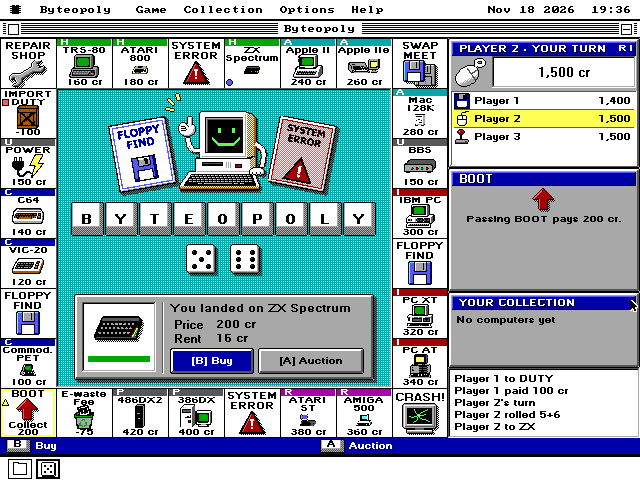
The board has 28 spaces. Sixteen are computers in six sets: Commodore, home micros, Apple, IBM, the 16-bit rivals and the power PCs. Prices rise as you go round, from the Commodore PET at 100 credits to the 486DX2 at 420. Two more spaces are utilities, POWER and BBS, whose rent depends on the dice. The rest are corners, charges and two decks of cards, Floppy Find and System Error.
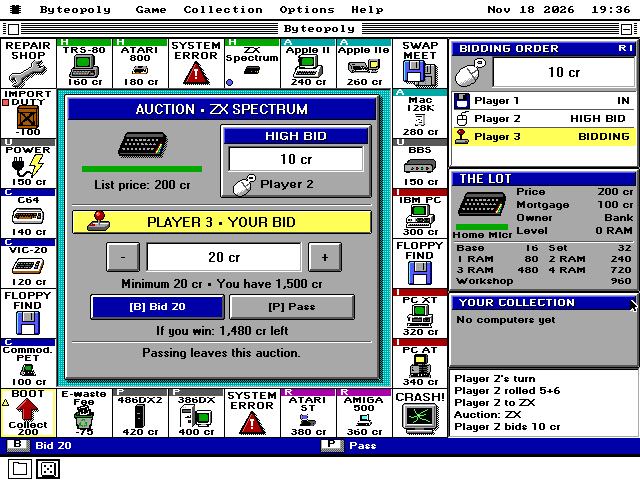
Own every computer in a set and its rent doubles. Then add RAM chips, up to four, and a workshop, and the rent rises up to 60 times its base. When you run short you can mortgage, sell upgrades or trade with another player. A machine nobody buys goes to auction. CRASH! sends you to the Repair Shop.
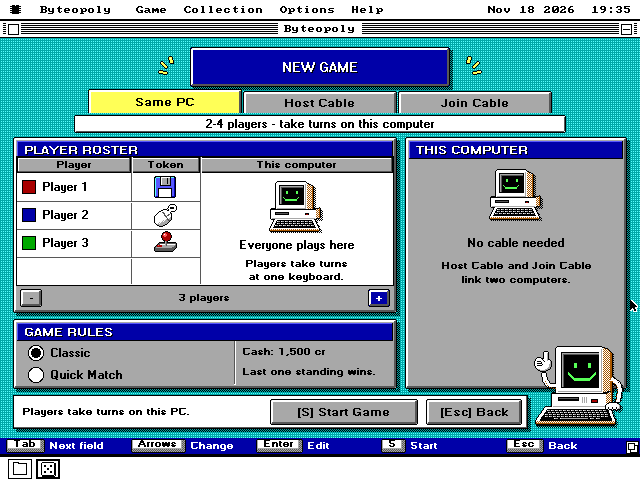
Everyone starts with 1,500 credits. Classic play goes on until one player is left. Quick Match ends after 10, 20 or 30 rounds, and the richest player wins.
02 / On the screen
On the screen
03 / How it works
How it works
On one PC, the players share the keyboard and the mouse. Between turns a screen says whose turn it is and waits until that player presses Enter. A key held down from the turn before does not count.
On two PCs, the machines are joined by a null-modem cable, a serial cable wired so each PC's send line reaches the other's receive line. The seats can be split any way: one and one, two and two, one and three. One PC is the banker. It works out every roll, purchase and payment, and the other PC replays the banker's results in step. Every message carries a checksum and is acknowledged, and both PCs compare a summary of the whole game after every change. If the cable is pulled, the game pauses and carries on from the same move when it is back.
Byteopoly is written in C and compiled with the toolchain os8088 ships for C programs. The 3D boxes, buttons, tabs and panels come from a drawing kit written for it, which other C games can now use. The screen is drawn in strips and only the parts that changed are drawn again. When the first version was measured on MartyPC's emulated 4.77 MHz IBM PC with VGA, ending a turn took 2.1 seconds, opening a player's collection 1.5 seconds and starting the program 16 seconds. The 3D look came later and has not been timed the same way.
The music and the 20 sound effects play on an FM sound card such as the AdLib, or on the PC speaker. Options turns either off. A game can be saved and loaded again, and a damaged save file is refused rather than half-read.
04 / What it does not do
What it does not do
There are no computer players. Every seat is a person.
Two PCs at most, over a cable. There is no modem or network play. The cable game has been tested between two emulated PCs with a relay that drops, repeats and damages messages, but not yet over a real cable.
Some pages are slow on the original PC. Turning a page of the rules takes about 4 seconds on a 4.77 MHz XT.
05 / Run Byteopoly
Run Byteopoly
Get the Byteopoly disk from the release zip, in
PROGRAMS/BYTEOPLY/, in the size your drive takes. It is also on the live USB and CD, and on The Wire.Boot the system disk, put the Byteopoly disk in drive B and open it.
Double-click
BYTEOPLY.O88. Add players with the plus button, then press S to start.Press Space to roll, B to buy, A to auction and E to end your turn. The bar at the bottom always lists the keys that work.