Spotlight › isoTron
A light-wall duel on a 4.77 MHz PC
isoTron puts you and the computer on a raised slab, each leaving a wall the other cannot cross. It is a remake of Novatron, a 1982 IBM PC game, written in 8086 assembly, and it plays in a window or full screen in colour.
- a step on a 4.77 MHz XT
- about 0.5 ms
- tallest tower
- 4 slabs
- memory it needs
- about 118KB
It runs in a window on VGA, EGA, CGA and Hercules. Full screen it uses the colour the card has: four colours on CGA, the original's look, and sixteen on EGA and VGA.
What it is
A game from 1982, and the rule it is built on.
In a light-wall game two riders move across a floor without stopping, and each leaves a solid wall behind. You can turn left or right but never stop. Hit any wall, yours included, and you lose. The idea came from the 1982 film Tron, and it turned up on home computers within months.
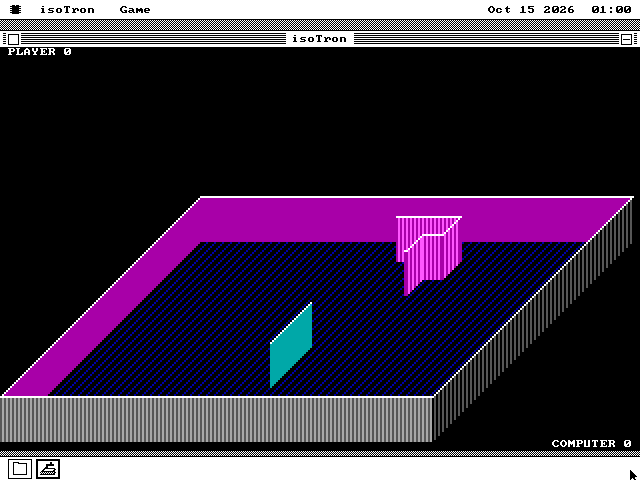
Novatron was one of them, sold for the IBM PC in 1982. It drew the floor as a raised slab seen from above and to one side, so the walls stood up from it in 3D. That view is called an oblique projection: depth is drawn as a line at 45 degrees.
isoTron is a new game with those rules. You ride against the computer. Lose three rounds in a row and the game is over. Win two in a row and the next arena is drawn one slab higher, with one more computer rider to beat. After four slabs the tower starts again. There are three skill levels: Rookie, Veteran and Lunatic.
Left and Right turn. A quick second tap turns you round. Up goes faster and Down returns to normal speed. P pauses, M turns the sound off, and F or Alt+Enter switches between a window and full screen. The sounds come from the PC speaker: a tick as your wall grows, a falling sweep at a crash, and a chime when the tower rises.
See it running
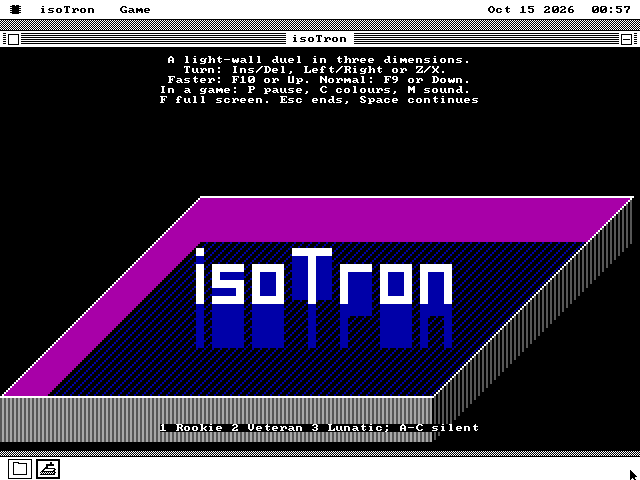
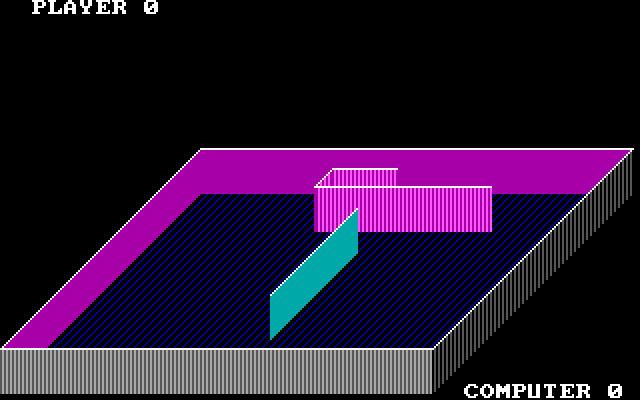
The title screen in a window, and a round full screen in sixteen colours.
How it works
Why an 8088 can keep up.
One column a step
The arena is never redrawn while a round is on. Each time a rider moves, its wall grows by one column of the picture, and nothing already on the screen is drawn again.
Because walls in front hide walls behind, the game only has to check a short run of grid cells to know how much of the new column shows: at most 22. On an emulated 4.77 MHz IBM PC a step costs about 2,400 processor cycles, which is about half a millisecond.
The same speed on every PC
The riders move by the clock, not as fast as the machine allows, so a round plays at the original's pace on an XT and on a 486 alike. On the emulated 4.77 MHz PC the measured pace is within a percent of the target.
Each new arena is drawn onto the screen piece by piece, rims and faces first and the outline last, in about a second and a half, the way the original drew it.
It fits a 256KB PC
The program is about 21KB, or 16KB on the disk. It asks for 63KB to hold the picture and 30KB to work in, about 118KB in all, which a 256KB machine has.
On the 128KB build of os8088 there is not enough room, and the window says so in one sentence with the figures, instead of starting.
What it does not do
Where it stops, and why.
- It is not Novatron. No code from the original is in it; it was written from the rules seen in the 1982 game, and every picture is drawn by the program.
- It is one player against the computer. There is no game for two people at one keyboard.
- Hercules has no colour, so full screen on a Hercules card is in black and white patterns, as the window is on CGA and Hercules.
- It does not run on the 128KB build of os8088.
Run it
It is on the software disk, in the games folder.
-
Boot os8088 with the software disk in the second drive.
-
Double-click Disk B, and open the GAMES folder.
-
Double-click ISOTRON.O88.
-
Press 1 for a Rookie game, and F for full screen.
It is on the 1.44MB, 1.2MB and 720KB software disks and on the live USB image and CD. On a 360KB XT use games360.img; it is not on apps360.img. It is also in The Wire.