Spotlight › Dot Delirium
A maze chase sized to the screen
Guide Smiles through three mazes, eat the dots, and turn out of sight to escape four ghosts. Dot Delirium was written from scratch for os8088 and runs on a 4.77 MHz IBM PC/XT.
- boards
- 3
- on a 4.77 MHz XT
- 16 to 18 frames a second
- smallest machine
- 128KB
The ghosts patrol until they see you down a straight row or column. Eat dots for points, use power pellets to eat ghosts, and save your score to disk with three initials.
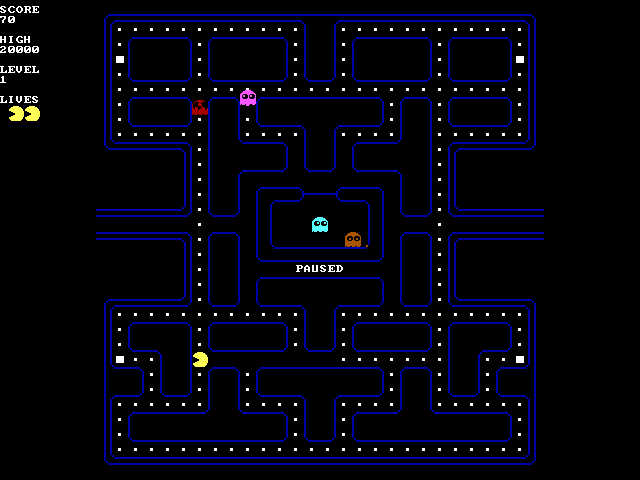
Playing it
Dots, pellets, ghosts and three boards.
A maze chase is a game of moving through passages while enemies pursue you. You steer Smiles, eat every dot on the board, and avoid four ghosts. A power pellet turns the ghosts blue, and while they are blue you can eat them for points.
There are three boards: the classic arcade layout with 240 dots, SPIRAL with 270 dots and long halls, and COMB with 278 dots, vertical combs and an open middle. The board changes every three levels.
A dot is 10 points and a power pellet 50. Ghosts eaten on one pellet are 200, 400, 800, then 1,600. Fruit appears twice a board, worth 100 points on the first level and up to 5,000 later. You get one extra life, at 10,000 points. The six best scores are saved to disk with three initials each.
Arrows or WASD steer. Enter or Space starts a game, P pauses and F switches full screen. Esc leaves full screen or ends the game. Sound comes from the PC speaker and is on when the game opens.
See it running
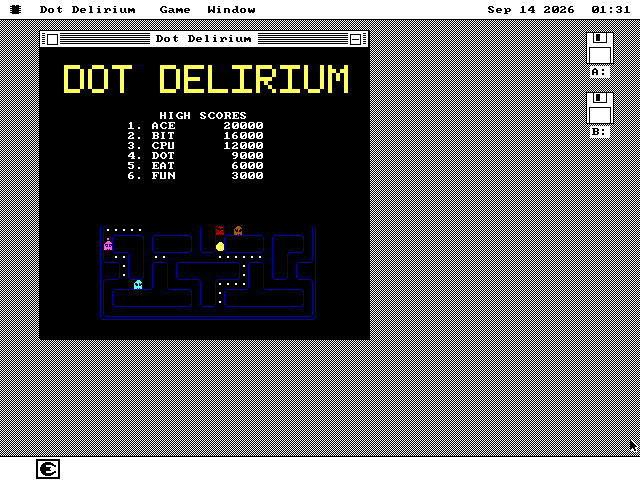
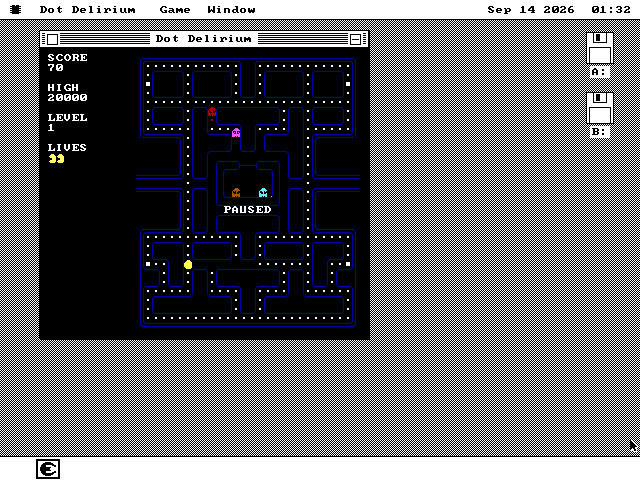
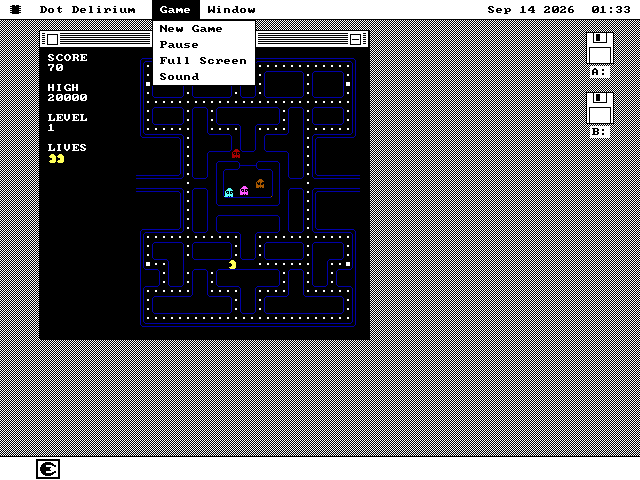
The title screen, a game in a window, and the menu.
How it works
A board that fits the screen, ghosts that need to see you, and what a frame costs.
The board fits the screen
The maze is always 28 tiles across and 31 down. The size of a tile changes with the display. VGA and CGA are color graphics cards; Hercules is a monochrome graphics card from 1982.
| display | screen | tile |
|---|---|---|
| VGA, window | 640x480 | 16x13 |
| Hercules, window | 720x348 | 16x9 |
| CGA, window | 640x200 | 8x4 |
| CGA, full screen | 640x200 | 16x6 |
So the board is bigger on a Hercules card than on CGA. Press F and it is laid out again for the whole screen.
Ghosts chase what they can see
Each ghost patrols its corner until it sees Smiles along a straight row or column. Then it heads straight for him and remembers the tile where it last saw him.
If he is gone when it gets there, it goes back to patrolling. To break a chase, turn out of sight.
16 to 18 frames a second on a 4.77 MHz PC
Each moving character is drawn with one drawing call a frame. Measured on an emulated 4.77 MHz IBM PC with the demo playing itself, in a window and full screen: VGA 17.8 and 18.2 frames a second, CGA 17.4 and 18.2, Hercules 16.8 and 18.2.
The system clock ticks 18.2 times a second, and that is the game's ceiling. A game you steer on the largest board, VGA in a window, runs at about 16.
What it does not do
Where it differs from the arcade game.
- It is a new game in the Pac-Man tradition, not a port of the arcade game. For that, PaccMan has a page of its own.
- Ghosts do not know where you are at all times.
- There is one extra life, at 10,000 points, and no more.
- It took the older Pac-Man's place on the floppies. That Pac-Man is still in The Wire.
Run it
It is on the software disk, in the games folder.
-
Boot os8088 with the software disk in the second drive.
-
Double-click Disk B, and open the GAMES folder.
-
Double-click DOTDEL.O88.
-
Press Enter to start.
On a 360KB XT it is also on games360.img, at the top of the disk.