Spotlight › DOS box
Run MS-DOS programs on os8088
The DOS box runs real MS-DOS programs on os8088 without DOS underneath it. Keep os8088 loaded with 437 KB for your program, or shut it down to make room for 586 KB.
- Reports as
- DOS 3.30
- OS stays loaded
- 437 KB
- OS shuts down
- 586 KB
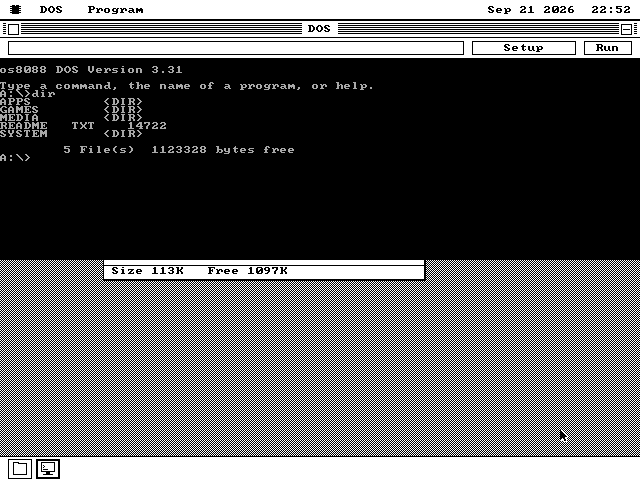
DIR here is listing the os8088 system floppy, which is FAT12 -- the same
format DOS floppies use.What it does
What a DOS program expects from the computer, and how the box provides it.
MS-DOS was the operating system almost every IBM PC ran in the 1980s. It provided services that programs needed. A game might ask it to read a key. An office program might ask it to open a file or report how much memory was available.
Programs made these requests through interrupt 21h, a software call to the operating system. The program supplied a request and waited for an answer. It expected DOS to be there.
os8088 is a separate graphical operating system with no DOS underneath it. The DOS box answers those requests itself. The program believes it is talking to DOS. When asked for its version, the box reports DOS 3.30.
Double-click a .COM or .EXE file, the two DOS program file types, in a Disk window. os8088 recognises both types and starts the DOS box for you. Its floppies use FAT12, the same disk format used by DOS floppies. DOS programs can read and write them directly.
While a DOS program runs, it takes over the whole screen and the whole machine. The desktop is frozen. When the program exits, the desktop returns. The selected memory mode determines whether os8088 resumes or the machine restarts into it.
See it
The box, the choice it offers, and a DOS program running.
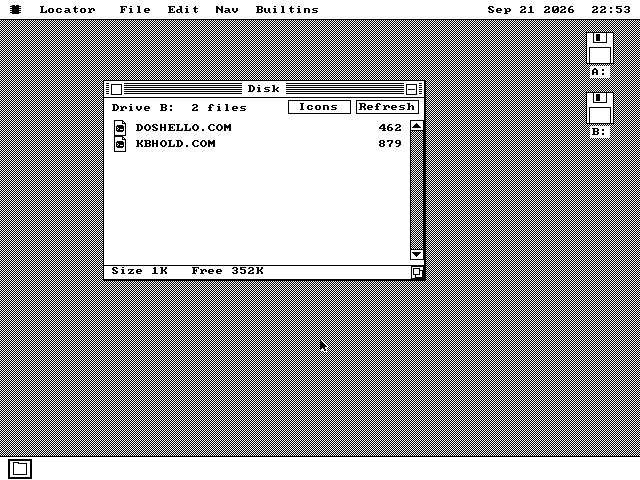
.COM gets an icon built from the DOS box's own, which is how os8088 shows a document and the program that opens it.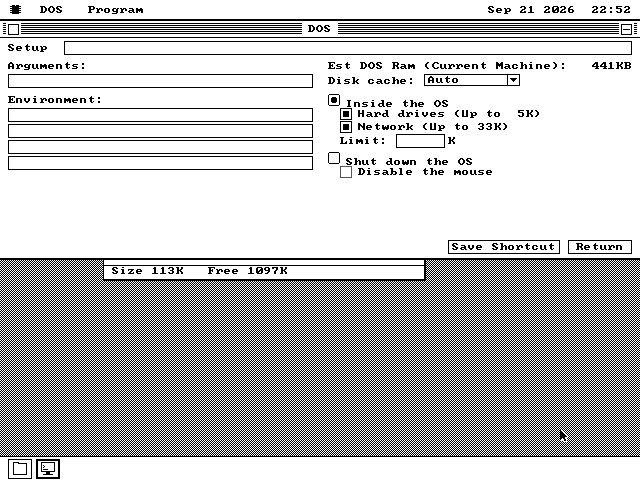
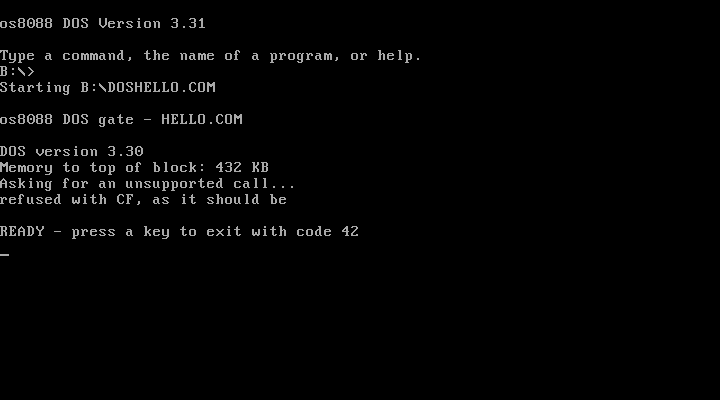
Two ways to run
Choose whether os8088 stays in memory while your program runs.
The DOS box has two choices in its setup area. Inside the OS is the default. os8088 stays loaded and the DOS program gets 437 KB of memory. When the program exits, the desktop resumes.
Shut down the OS unloads os8088 entirely. Only a disk reader and the software that answers DOS calls remain. The program gets 586 KB because os8088 is no longer in memory. That is 149 KB more. When the program exits, the machine restarts into os8088.
Both figures were measured on an IBM 5150 with 640 KB of memory and a 360 KB system disk. The choice trades an immediate return to the desktop for more room to run a program.
A program that does not fit reports Program too big to fit in memory. This is the DOS error message, not a crash. If it appears with Inside the OS selected, try Shut down the OS.
What ran
Twelve of fifteen tested programs ran, with some checks reaching only an opening screen.
Fifteen real DOS programs were tested on an emulated 8088, a simulated computer processor running at 4.77 MHz. It used VGA, a PC graphics standard. Twelve ran. Aldo, Joust, Rockford, Number Munchers, Star Trek and Boloball ran from the box's window with os8088 still loaded.
Six needed Shut down the OS for more memory. Commander Keen 2 reached the title level. Tom & Jerry reached level select. Chip 'n Dale reached the high-score table. Battle Chess reached the title screen. Test Drive reached the adapter menu. Test Drive III ran through the intro. These results do not establish that every part of each game works.
The other three did not produce a running result. One required a .BAT batch file, a file containing a sequence of commands. The box cannot interpret these files. Another was slow while unpacking 316 KB of compressed data on the 4.77 MHz machine. The last was not reached because of a limit in the automated test setup. That result did not show a fault in the box.
A command interpreter with no file behind it
How an installer can copy files through a command interpreter that is not on disk.
COMMAND.COM is the DOS command interpreter, the program that carries out typed commands. DOS programs also ask it to perform jobs such as copying or deleting files. The DOS box recognises requests to run this name. It carries out the requested command and returns to the program. There is no COMMAND.COM file on disk and nothing is loaded.
The supported commands are COPY, XCOPY, MOVE, DEL (ERASE), REN (RENAME), MD (MKDIR), RD (RMDIR), CD (CHDIR), TYPE, VER, ECHO and REM.
Prince of Persia's hard-disk installer asks COMMAND.COM to copy its files. The installer now runs to completion. It leaves all 28 game files with sizes matching exactly to the byte. It also deletes itself as intended.
What it does not do
What to expect before choosing a program to try.
- There is no interpreter for
.BATbatch files. A program started through a batch file cannot be launched by that name. - The DOS box is absent from the 128 KB build. That build cannot link file types to programs for double-click launching. It also has too little memory to host a useful DOS program.
- A running DOS program owns the machine. Nothing else on the desktop moves until it exits.
- The box provides a DOS program's view of DOS. It is not a copy of DOS itself. A request it does not implement is refused rather than answered incorrectly.
Try it
The DOS box ships in APPS on all four system floppy sizes, and on the live USB image and live CD.
-
Boot os8088 from the system disk.
-
Put a floppy containing a DOS program in the second drive.
-
Open that drive's Disk window. Double-click the program's
.COMor.EXEfile. -
Alternatively, open the DOS box from the APPS folder on the system disk. Type a command or a program name at its prompt.
DIRlists the contents of a floppy. Press Alt+Enter to switch between the window and a full-screen text view. This changes the display, not the memory mode.