Toshiba T1100 Plus
Laptop, 1986
A 1986 laptop with an 8086 and a blue LCD. os8088 runs its CGA driver here. The 360K images were written onto 720K floppies to get them in.
os8088 on real hardware
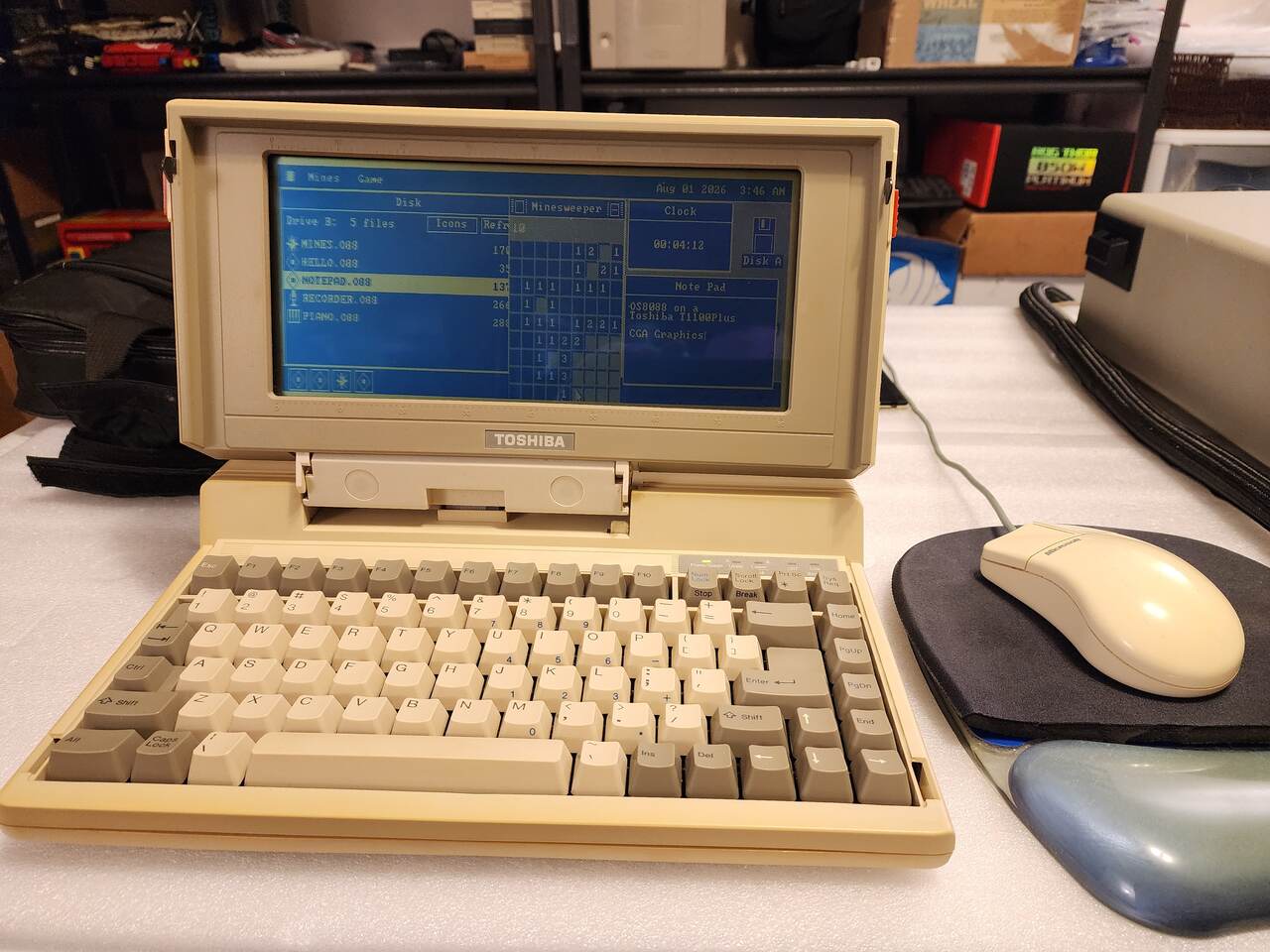
See it running
View all photos & details- CPU
- 8086, 7.16MHz
- screen
- blue LCD, 640 x 200
- mouse
- Microsoft serial, COM1
Manuals & resources
All sources & referencesRunning os8088?
Share photos of your setup with the community. Open a GitHub issue and attach your images.
Submit your photos on GitHubHistory, photos & source references
The same windows, at half the height
CGA's 200 lines where VGA has 480.
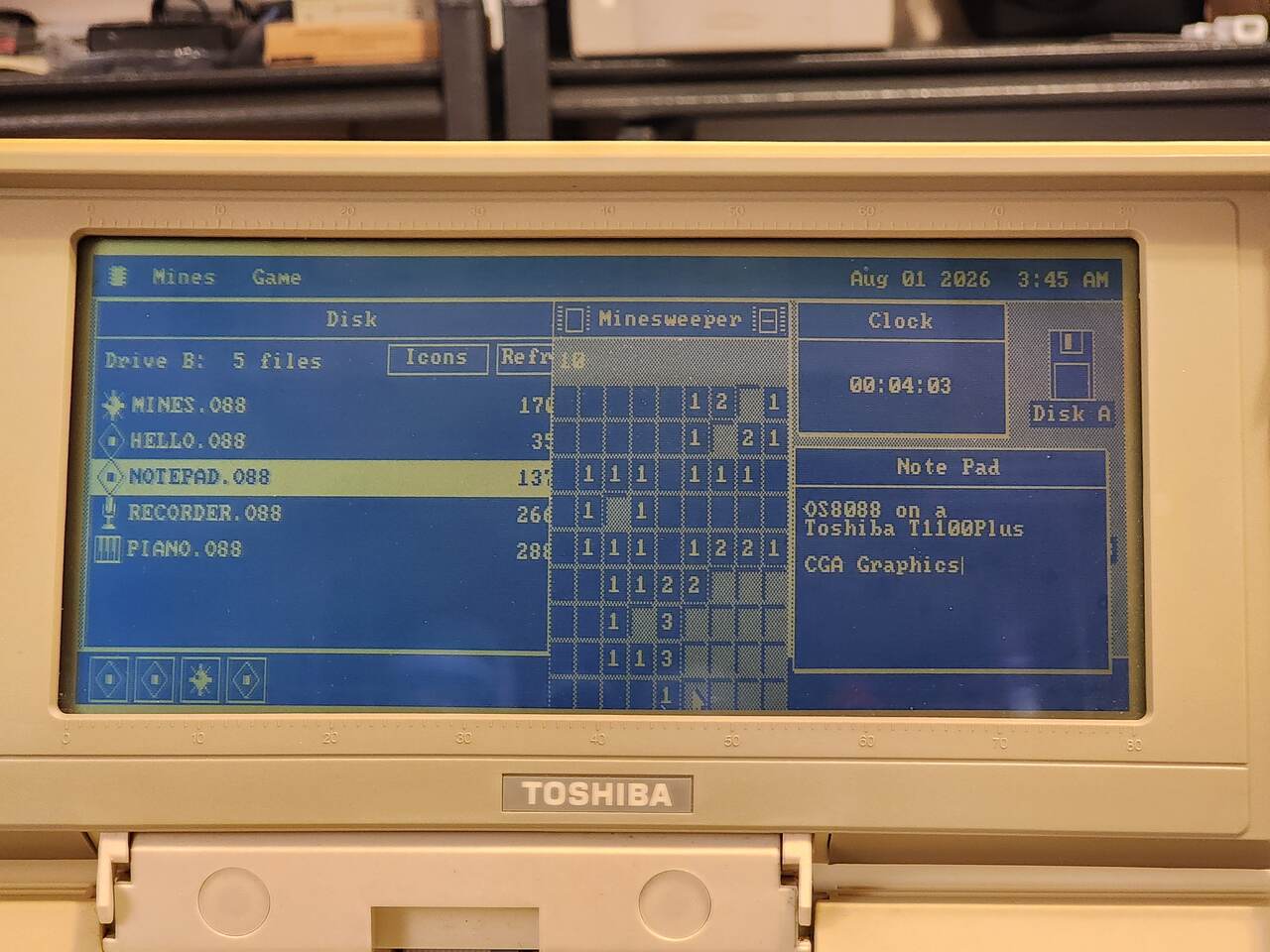
The T1100 with its reviewers' complaints removed
A second drive, a new keyboard, and twice the speed.
Toshiba's T1100 of 1985 was not the first laptop (the PC Magazine reviewer who adopted one retired a diskless NEC Starlet to do it), but it ran IBM PC software on batteries from a built-in floppy drive, and that reviewer found one "fairly serious drawback": the keyboard layout. The Plus is Toshiba's reply. It has a redrawn keyboard, a second drive, a processor with a 16-bit bus in place of the 80C88, and a case of almost the same size and weight. The magazine made it an Editor's Choice: "Toshiba fixed everything we found deficient in the original T1100, then made it twice as fast." Only Toshiba's own 286-based T3100 beat it on the magazine's benchmarks.
Toshiba's advertising chose a different rival. Its brochure sets the Plus against IBM's PC Convertible, which weighed 12.2 pounds, stopped at 512K and needed add-ons for the serial, parallel and monitor ports that the Toshiba carries on its back panel.
The dissent was about the screen. The first machines kept the T1100's panel, which one PC Magazine editor likened to "a bad photocopy underwater". In 1987 Toshiba fitted a supertwist panel, reported by c't from CeBIT as the news on the model. It still has no backlight: a U.S. Navy laboratory that tried five laptops that summer for use aboard submarines found the Toshiba's display the worst of them in anything short of excellent light.
There is no hard disk, and Toshiba's price list offers none. Software still came on 5.25-inch disks, so the list carries an external drive at $499 and a Floppy Link to a desktop's drive at $199.
- introduced
- 1986
- price at launch
- $1,999 with 256KB
- RAM
- 256KB, or 640KB with a card
- drives
- two 3.5-inch, 720K
- weight
- 4.5kg
- battery
- NiCd, up to 8 hours
Sources
- Toshiba T1100 Plus PC Magazine, December 23, 1986, pages 122 and 123. The Editor's Choice, the changes from the T1100, the benchmarks and the screen.
- T1100 PLUS flyer Toshiba. The processor and its clock, memory, drives, ports, weight and battery.
- Portable Personal Computer Price List Toshiba America, June 16, 1986. The prices, the options, and no hard disk.
- T1100 PLUS brochure Toshiba America, 1986. The comparison with the IBM PC Convertible.
- T1100 PLUS maintenance manual Toshiba. The 80C86-2 and its two clock speeds.
- Laptops c't, May 1987, page 20. The supertwist screen.
- Laptop Computer Review, NSMRL Memo Report 87-4 U.S. Naval Submarine Medical Research Laboratory, August 1987. The screen without a backlight.
- Toshiba T1100 Wikipedia. The original T1100, and 1986 for the Plus.