Epson Equity I+
Desktop, 1987
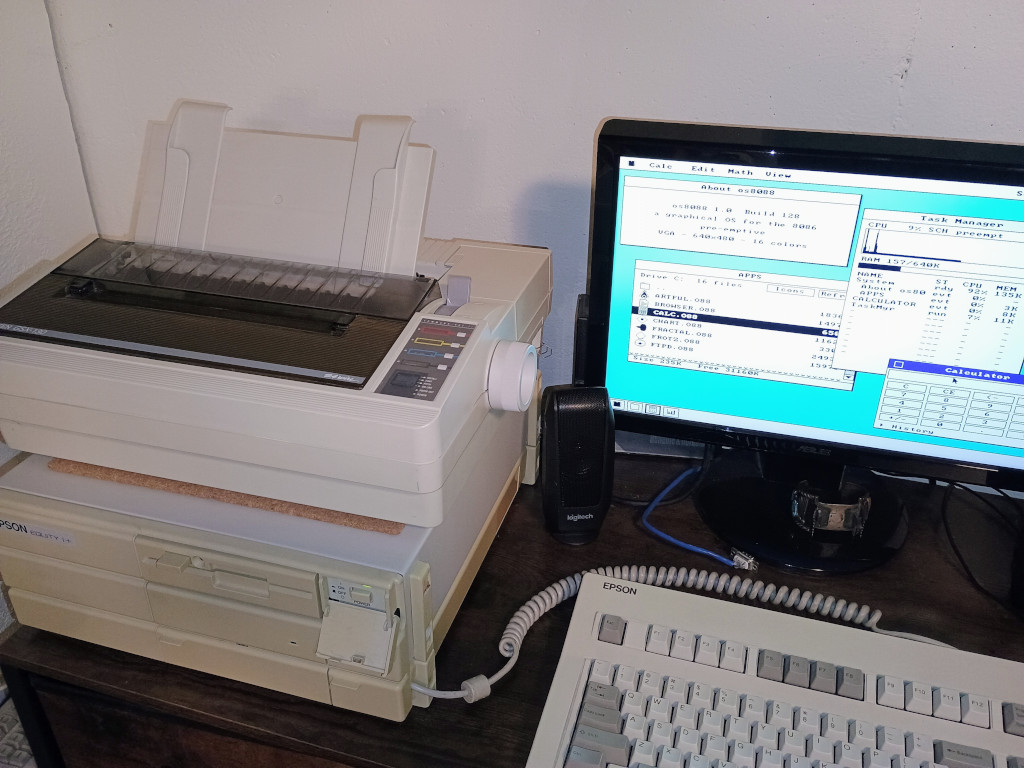
Epson's XT clone, in a unit its owner dates to 1989. There is a VGA card in one of its slots, so an 8088 gets the desktop the 286s get: 640x480 in 16 colors, off drive C:.
os8088 on real hardware
- CPU
- 8088
- display
- VGA, 640 x 480
- RAM
- 640K
Manuals & resources
All sources & referencesRunning os8088?
Share photos of your setup with the community. Open a GitHub issue and attach your images.
Submit your photos on GitHubHistory, photos & source references
The Equity I with the slots and the speed put back
An 8088 clone Epson was still building at the end of 1988.
Epson's first PC compatible, the Equity I of 1985, was built down to a price: $795 bought IBM PC speed, 256K and three slots, one of them owed to the display adapter. The I+ is that machine with the economies taken back out. Although it was never the quick Equity (the Equity II had a NEC V30 and the Equity III an 80286 before it arrived), Modern Electronics called it "one of the best low-cost clones" within months of its release.
A switch on the front panel moves the processor between the IBM PC's clock and a little more than twice that, without a reboot, and the power light turns from red to green to say which. Memory is complete on the motherboard, there is a socket for an 8087, and the floppy BIOS will also run a 720K 3.5-inch drive -- and stops there: no 1.2MB drive, no 1.44MB. What the price still leaves out is video. Every I+ needs a card in one of its slots, and VGA was not among the four Epson listed.
Epson's service bulletins are the record of what went wrong. A Microsoft serial mouse on the built-in port could hold up power-on until someone moved it. Units built from March to May 1988 with Siemens processors could fail a file copy at the high speed and pass it at the low one. EGA and VGA cards picked up noise from the expansion bus unless they sat in the slot nearest the power supply; that fix went into production in December 1988, which also says how long Epson kept building an XT-class machine.
- introduced
- 1987
- CPU
- 8088, 4.77 or 10MHz
- slots
- five, 8-bit
- video
- on a card: mono, CGA, multi-mode or EGA
- drives
- 360K floppies, 20MB hard disk
- list price, November 1987
- $1,095, one drive, no video card
Sources
- Equity I+ User's Guide and Diagnostics Epson, 1986. The processor and its two speeds, memory, slots, ports, video options and drives.
- Equity I+ Product Support Bulletins Epson America, 1987 to 1990. The serial mouse, the Siemens processors, EGA and VGA noise, and the production dates.
- Epson Equity I PC Magazine, March 31, 1987, page 150. What the plain Equity I had.
- Buyer's Guide Family Computing, November 1987, pages 47 and 48. The list price.
- Modern Electronics, September 1987 The verdict.
- Epson Equity Wikipedia. The Equity line, its dates and its processors.
- os8088 on an Epson Equity I+ tfurr0ws, September 2026. The photograph, and the owner's date for this unit.