A 286 desktop, in VGA
Desktop
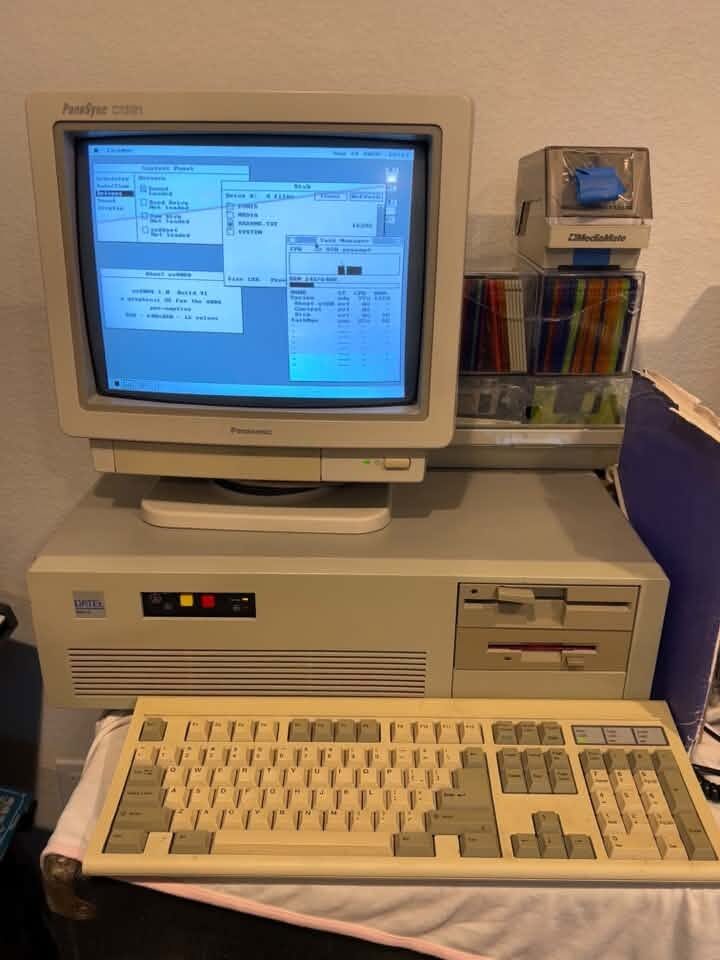
A 286 AT clone at 640x480 in mode 12h, on a Panasonic CRT.
os8088 on real hardware
- CPU
- 80286
- mode
- VGA 12h, 640 x 480
- colors
- 16
Manuals & resources
All sources & referencesRunning os8088?
Share photos of your setup with the community. Open a GitHub issue and attach your images.
Submit your photos on GitHubHistory, photos & source references
IBM's AT by other hands, with IBM's next video
What a 286 clone is a clone of.
A 286 desktop from anyone but IBM is an IBM PC/AT built by someone else. (IBM never said what AT stood for, and largely failed to trademark it.) Phoenix sold a compatible BIOS from 1984; Chips and Technologies followed in 1986 with the 82C206, one part doing the work of the TTL logic on IBM's board; and by 1988 Gartner counted 1.5 clones bought for every IBM PC. The processor had other makers too. AMD built the 286 under its second-source contract with Intel, and AMD and Harris took it to three times the clock of IBM's last AT.
VGA is the part IBM did not build into an AT. It arrived with the PS/2 in the spring of 1987, three months before the last ATs were made, and clone cards were on sale within six months. (IBM did offer a PS/2 Display Adapter for machines without it.) The original carried 256KB of video memory, which mode 12h uses as four bit planes.
- 80286 introduced
- February 1, 1982
- IBM PC/AT released
- August 14, 1984
- PC/AT clock
- 6MHz, 8MHz from April 1986
- fastest 286s
- 25MHz, AMD and Harris
- VGA introduced
- April 2, 1987
- 286 address space
- 16MB
Sources
- Intel 80286 Wikipedia. The processor's date, its clock speeds, and the AMD and Harris parts.
- IBM Personal Computer AT Wikipedia. The AT's dates and clock speeds.
- Video Graphics Array Wikipedia. VGA's arrival with the PS/2, its memory, and how soon it was cloned.
- INT 10h, Set Video Mode Ralf Brown's Interrupt List. Mode 12h by number.
- IBM PC compatible Wikipedia. Phoenix's BIOS and Gartner's count.
- Chips and Technologies Wikipedia. The 82C206.
- AMD Wikipedia. The second-source contract.